


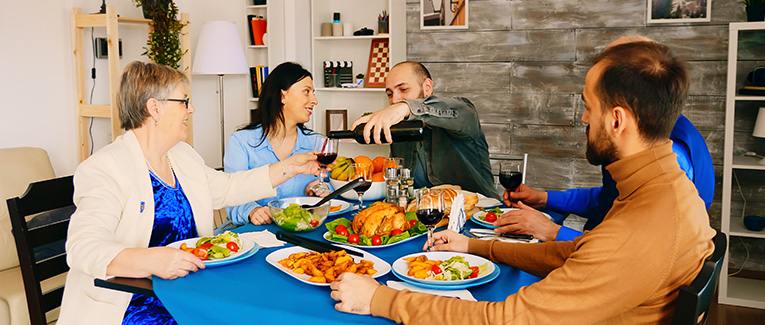
Welcome! When traveling abroad, an interesting way to experience the culture of a new country is by visiting its people in their homes. It is there, in the exchange of conversation and ideas, that cultural similarities and differences can be appreciated in a personal way, as guests and hosts open the door to a better understanding of each other. What follows is a “cultural road map” to American hospitality.
- Home Hospitality Programs
- Why Americans Offer Home Hospitality
- Other Kinds of Hospitality
- The Hospitality Invitation
- Who is Invited
- When to Arrive
- What to Expect when Visiting an American Home
- What to Expect at Dinnertime
- Spoken Communication
- Unspoken Communication
- Bringing the Evening to a Close
- Signing the “Guestbook”
- Expressing Appreciation to the Hosts
- In Conclusion
Home Hospitality Programs
At international centers throughout the U.S., home hospitality programs that include family and group dinners offer Americans and international visitors the opportunity to meet each other. Often both visitors and hosts are given brief biographical information about one another before the visit takes place, so that each come to the meeting with a sense of ease and some knowledge of the others.
Why Americans Offer Home Hospitality
There are several reasons why people in the U.S. open their doors to international visitors:
- Most Americans live in a nuclear family(parents and dependent children) rather than a larger extended family. As a result, they develop friendships outside the family rather than within their own family. Therefore, dinner invitations are often offered to acquaintances (people who are not well known to them) so that they may come to know more about each other.
- The concept of volunteerism is strong in America. Many Americans volunteer; that is, they give their time and talents without receiving payment to enrich their lives outside their immediate family and their jobs. Host families who volunteer in home hospitality programs receive their “payment” not in money, but in the pleasure taken from extending hospitality to others and from learning about other cultures.
- Many Americans wish to increase their own and their children’s knowledge of the world beyond that is offered in newspapers, on television, and in school. Hosting international visitors gives them a unique opportunity to learn about different places in a personal way. You may have noticed, since coming to this country, that most American newspapers carry very little news of foreign countries. Inviting international visitors into their homes is one way Americans can overcome this “news shortage.”
- A home hospitality program offers Americans who have traveled the chance to return the hospitality that has been shown to them while abroad.
Other Kinds of Hospitality
The structured home hospitality program is just one way to meet people. You may also be invited to the homes of American friends and colleagues who wish to become better acquainted with you. Relaxed conversation around the dinner table, away from the work or school setting, offers a chance to learn more about the other. The customs described in this guide apply to both hospitality experiences.
The Hospitality Invitation
The point at which a casual comment becomes a firm commitment to visit someone’s home varies from culture to culture. In the U.S., if an American says: “We must get together some time; perhaps we could meet on Tuesday,” and his friend agrees, a firm commitment has not been made.
However, if that person names a specific date and time, for example: “How would you like to come to dinner on Tuesday at 6:00?” and his friends accepts, the American host assumes that a firm commitment has been made and that his friend will arrive on Tuesday at 6:00 PM. Because invitations are sometimes agreed upon in informal conversation and will probably not be followed by a written invitation, many people carry pocket calendars in which to mark the date of the engagement and the host’s telephone number (should cancellation be necessary due to an emergency). When a written invitation is received, the guest is expected to telephone or write to the host to accept or decline the invitation. At the time of acceptance, guests notify the hostess of any medical or religious restrictions with foods, such as pork, beef, or beverages containing alcohol. Once an invitation has been accepted, the commitment to attend is regarded as a firm obligation to be respected by both guest and host, even if other invitations for the same time are received later. In addition, it is assumed that guests will accept no other invitations for a later hour on the same evening they are invited for dinner.
Who is Invited
Unless the host indicates otherwise, an invitation offered to a guest is only for that person. Americans usually prepare for a specific number of guests and often plan to have a similar number of male and female guests. Therefore, for a dinner guest to arrive with one or two unannounced friends is considered impolite and embarrassing to the hosts who may not have prepared enough food for extra people, or who may not have enough room for them at the table.
When a social rather than business invitation is extended to a married person, the assumption is that the spouse is invited, as well. The guest should ask the host if they have any questions about this.
When to Arrive
In the U.S., punctuality is one of the most highly valued traits a person can have. To be late for an engagement or an invitation is insulting to the person who is kept waiting. The social error is even greater if a meal is involved or if both parties are expected at another destination, such as a concert or play, at a specific time. Therefore, guests invited for dinner at 6:00 PM on Tuesday, for instance, are expected to arrive at 6:00 PM, perhaps at 6:05, but not later than 6:15. Guests who are unable to be on time telephone their hosts at the earliest possible moment both to explain their lateness and to give an estimated arrival time.
What to Expect when Visiting an American Home
American behavior in the home reflects a belief in equality between the sexes and the value of informality. Some of the customs described in this section may be new; some may be quite familiar. They are presented to inform and for interest.
- Should the host family provide transportation, it is not uncommon for a woman from the household to arrive alone to escort a guest to the family home. Guests from nations where women are secluded from males might be surprised by this. However, in the U.S. such behavior is considered appropriate and carries no romantic meaning.
- Americans usually entertain simply and informally. Hosts often will say, “Make yourself at home,” to a guest. This is considered to be a positive, welcoming statement. To be treated like a member of the host’s family is a gesture of respect, one intended to show the host’s high regard for the guest.
- The picnic is one of the most popular ways for Americans to entertain in the summertime. The main focus at such an event is the manner in which the food is prepared. Meat, most often chicken, pork, or beef steak, is grilled outdoors on a charcoal fire. Often a male is in charge of cooking and tending the fire. The party centers around this activity. Such informal gatherings usually take place in the late afternoon or early evening, and dress for such occasions is almost always very informal.
- Dress for most evenings is informal— sports jackets and slacks for men, “street” dress for women, though less informal suits are accepted, as well. National dress worn by international visitors is generally of high interest to Americans who have not had the opportunity to travel to their guest’s country.
- Alcoholic drinks are sometimes offered before and during the meal. Guests who are unable to consume alcoholic beverages for religious, medical, or personal reasons may request non-alcoholic drinks.
- Men and women who are not members of the same family converse in public and share meals together. In some cultures, men and women are entertained in separate quarters of the house. Some visitors are surprised, therefore, to find that such social segregation of the sexes does not exist here. In addition, like other Western women, American women converse with other men, even if their husbands are not present.
- Many Americans have household animals or “pets” which are allowed to stay in all parts of the house, including the kitchen. Dogs or cats in a home are treated almost like members of the family. The following points should be kept in mind regarding household pets:
- By law, dogs and cats must be inoculated against contagious diseases.
- Owners take their animals to the veterinarian on a regular basis to maintain the health of their pets.
- Household pets are generally tame and friendly enough to be with small children as well as adults.
What to Expect at Dinnertime
- Hosts usually invite guests into the dining room after a brief period of socializing in the living room.
- Dinner is generally served between the hours of 6:30 and 8:00 PM and is considered to be a family meal. The children of a family, as well as the husband and wife, will probably share the meal with guests.
- The evening meal is the main meal of the day, rather than the midday meal.
- Dinner may be served “family-style.”Dishes of food are passed from person to person for each to take a portion on their own plates. Guests who are unfamiliar with foods presented often take a small amount of each food passed to them, taking more as desired when the dishes are offered again.
- Dinner may be served “buffet-style.” In this case, food is placed on a side table for guests to serve themselves before proceeding into the dining room or living room to eat the meal. Guests who finish their first serving and wish to take a second serving simply return to the buffet table to “help themselves” to more.
Note: International visitors who are unfamiliar with this form of “self-service” often ask to follow after another guest in order to become acquainted with the serving procedure. - Place settings at the table may include two forks, two spoons, and a knife. Guests who are not certain which food requires which piece of silverware often observe the table behavior of the host and hostess for guidance.
- Some families offer a prayer of thanksgiving before beginning each meal. Saying such a prayer is referred to as “grace” and often takes place in the homes of religion-oriented families.
- Guests usually refrain from beginning the meal until everyone has been served and the hostess has lifted her fork. An exception to this is the “buffet-style” meal in which guests begin eating as soon as they are seated.
- Dinner may be served in two, three, or four courses:
- Soup, salad, or fruit may be offered as a first course.
- The main course or central part of the meal is usually defined by the meat, poultry, or fish served. All other foods, such as vegetables and starches (potatoes, rice, or noodles) are considered “side” dishes and are served in smaller portions with the meat or fish. Note: Rice is generally not considered a main food in the U.S. Therefore, only a small portion may be prepared for each guest. It may be helpful to observe the hosts to see how much rice they serve themselves.
- A salad of lettuce and raw vegetables or fruit may be served before, during, or after the main course.
- Dessert is served at the end of the meal and may be a sweet cake or pie, fruit, ice cream, or pudding. Coffee is usually served with dessert.
Note: Guests may compliment the hostess on her cooking if they wish to do so.
- “Seconds” (a second helping of food) might be offered only once to a guest.
Note: In many American homes, the host refrains from offering the food more than a second time for fear offending the guest by his persistence. International visitors who are accustomed to refusing the second helping a number of times should realize that the offer may be extended only once. - American men often assist women with food preparation and cleaning tasks. At an informal dinner, for example, the host may prepare the steak, make the salad, or remove dishes from the table.
- The traditional concept of “men’s work” and “women’s work” is changing in the U.S. as more women enter full-time professional careers outside the home. Household chores such as dishwashing, cleaning, and laundry are often shared on the basis of what needs to be done at the time, rather than on the basis of whether it is considered to be the man’s or woman’s role.
- Individuals receive further assistance in the kitchen from a variety of electrical appliances ranging from a blender or food processor to a dishwasher. Appliances are relatively inexpensive in the U.S. These machines substitute for expensive household help.
Note: Some Americans offer to take their international guests on a “house tour.” Some visitors regard this as an impolite gesture intended to allow Americans to display their material wealth. However, American hosts may offer such a tour to satisfy any curiosity a visitor may have about the way Americans live, as they themselves would be curious when visiting another country.
Spoken Communication
Visitors to other countries may have questions concerning what is “acceptable” or “unacceptable” conversation in a different culture. In addition, topics of conversation chosen by hosts in a country may seem unusual to an international visitor. Three ways to start a conversation in America, which are commented on by many visitors to the U.S., are: (1) the weather, (2) questions about a visitor’s homeland, and (3) questions regarding a visitor’s occupation.
- Americans almost always talk about the weather when they wish to find a topic common to all guests. The weather, of course, is a relatively neutral, safe subject that generally does not stir emotions. This preliminary conversation leads to more serious topics once the guests have become more comfortable.
- Questions about an international guest’s country – even when they may seem terribly obvious to the guest – indicate a desire to find out more about the visitor and his or her nation. By answering in a thoughtful way, visitors can fulfill the role of “citizen-ambassador.”
- Questions regarding occupation are only asked out of interest, since one’s occupation does not necessarily indicate one’s social class. Hosts may ask guests about their occupation in order to discover areas of common interest to then discuss.
American individualism is often shown in conversation. The expression of ideas is highly valued, even when those views oppose opinions held by others who are present. It is not impolite to disagree with another person if the disagreement is made respectfully. It is okay to have a healthy and respectful debate on interesting topics in order to learn about new perspectives/ideas.
Most Americans not only praise, but also openly criticize their own government in a way that is not encouraged or permitted – socially or legally – in many other nations.
Although Americans enjoy lively discussions and are open with a wide variety of subjects, most are uncomfortable discussing what are considered to be, by U.S. standards, private or personal matters, such as:
- The amount of money they earn.
- How old they are.
- Why they have few or no children.
- The cost of their personal possessions (house, car, etc.).
Religion and politics are considered acceptable topics as long as guest and host alike respect each other’s viewpoint.
Unspoken Communication
Every culture has its own set of rules or guidelines regarding unspoken or nonverbal behavior. Certain hand or body gestures that are rude or insulting by one country’s standards may have either no meaning or a different meaning in another country. The following are examples of nonverbal gestures and their American cultural interpretation:
- Eye contact with women or elders. The willingness to look people “in the eye” regardless of sex or age is regarded as very positive. The reverse, avoiding eye contact, is regarded as a sign that one is trying to hide the truth or is uncomfortable.
- Shaking hands when introduced. Men in particular customarily shake right hands upon meeting. Children also often extend a hand to an adult when introduced. In the U.S., handshaking is common and expected behavior for men. Handshaking is optional for women. Therefore, men generally wait for a woman to extend her hand first.
- Kissing as a greeting. Men and women who know each other quite well may kiss one another’s cheek when greeting each other. Acquaintances and those being introduced, however, simply shake hands.
- The use of the left hand in passing foods or making toasts, etc. Americans give no significance or negative meaning to this.
- Pointing the sole of the shoe toward the head of another. American men often cross their legs by putting the ankle of one foot on the other knee, thus sometimes pointing a foot in a way that is quite unacceptable in cultures such as Thailand or the Arab world. In the U.S., however, this gesture carries no negative meaning.
Bringing the Evening to a Close
In the U.S., it is the guest, not the host, who chooses when to end the evening and return home.
- Guests entertained on a weekday evening (Monday through Thursday) or Sunday generally make their leave between 10:00 and 10:30 PM in order to allow the hosts enough time to wash the dinner dishes before retiring to bed.
- Social engagements on weekends (Friday or Saturday) often last longer, perhaps until 11:00 or 11:30 PM for dinner hospitality, or later for party hospitality.
Signing the “Guestbook”
On occasion, host families ask international visitors to sign a special guestbook. The address left in the guestbook may be the family’s only means for maintaining further contact with their foreign guests.
Expressing Appreciation to the Hosts
Some expression of thanks is considered appropriate when hospitality has been extended and received. Guests express appreciation in various ways:
- After staying overnight or spending time in someone’s home as a guest, some give a small “house gift” or a token of appreciation.
- After receiving dinner hospitality, guests often present a gift to the hostess. This is considered a nice gesture, but not a necessary one. Many international visitors give something distinctly from their homeland, such as postage stamps or coins to emphasize the special cross-cultural spirit of the evening.
- A written “thank-you” note or a telephone call to the hostess delivered or given within one week after the engagement is the most common and often most welcomed expression of appreciation.
In Conclusion
The cornerstone of international communication rests on the efforts of the people of many nations to develop a greater understanding and appreciation of one another. It is our hope that your experience with the people of the U.S. will be a step forward toward that goal, and that you will enjoy being with them as much as they will surely enjoy spending time with you.
Courtesy: Meridian International Center, Washington DC, USA.