


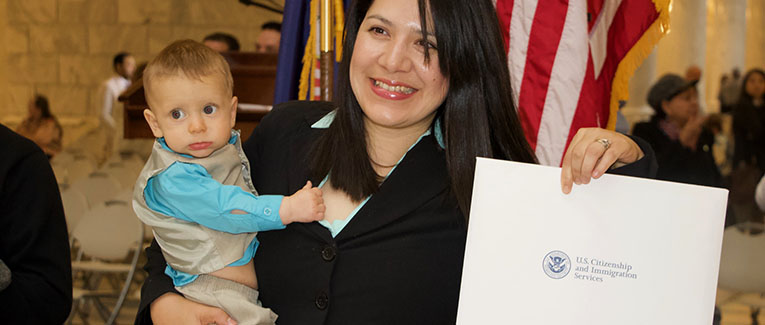
The Child Citizenship Act (CCA) of 2000 states that certain foreign-born, biological, and adopted children of U.S. citizens are able to obtain U.S. citizenship automatically. These children did not obtain U.S. citizenship at birth, but when they enter the U.S. as lawful permanent residents they are granted U.S. citizenship .
This law went into effect on February 27, 2001. On that date, children who met the eligibility requirements automatically obtained U.S. citizenship. Children who were already 18 years of age or older on February 27, 2001 cannot be grandfathered in. Therefore, they do not qualify for citizenship under the CCA, even if they meet all other criteria. If they wish to become U.S. citizens, they must apply for naturalization and meet eligibility requirements that currently exist for adult lawful permanent residents.
Eligibility
A child will automatically acquire U.S. citizenshp on the date all of the following requirements are met:
- At least one parent is a U.S. citizen,
- The child is under 18 years of age,
- If the child is adopted, a full and final adoption of the child, and
- The child is admitted to the U.S. as an immigrant.
As long as your child satisfies the requirements listed above, he/she automatically receives U.S. citizenship by operation of law on the day he/she is admitted to the U.S. as an immigrant. Your child’s citizenship status is no longer dependent on the U.S Citizenship and Immigration Services (USCIS) approving a naturalization application.
Proof of citizenship
If your child permanently resides in the U.S, you can obtain evidence of your child’s citizenship by applying for a Certificate of Citizenship. You would need to file a Form N-600 (Application for Certificate of Citizenship) and submit it to the local USCIS District Office or Sub-Office that holds the jurisdiction over your permanent residence.
You may also apply for a U.S. Passport from the Department of State (DOS). In order to obtain a passport for a child who became a U.S. citizen under the CCA, the following documents are required:
- Evidence of the child’s relationship to a U.S. citizen parent (a certified copy of the final adoption decree for an adopted child or birth certificate for natural child);
- The child’s foreign passport with USCIS’ foreign I-551 stamp or the child’s resident alien card; and
- The parent’s valid identification.

New Immigrants Insurance
Get QuotesFor visitors, travel, student and other international travel medical insurance.
Visit insubuy.com or call +1 (866) INSUBUY or +1 (972) 985-4400Children Residing Abroad
Some adopted and biological children do not qualify for automatic citizenship as stated under Section 320 of the Immigration and Nationality Act (INA). However, U.S. citizen parents may still apply for a U.S. citizenship for their adopted children who permanently reside abroad.
Automatic citizenship is not provided for children living outside the United States.
In order for a foreign-born child living outside the United States to acquire citizenship, the U.S. citizen parent must still apply for naturalization on behalf of the child. The naturalization process for this child cannot take place overseas. The child needs to be in the United States temporarily to complete the naturalization process and take the oath of allegiance.
To be eligible, a child must meet the following requirements:
- The child has at least one U.S. citizen parent (by birth or naturalization);
- The U.S. citizen parent has been physically present in the United States for at least five years, at least two of which were after the age of 14-or the U.S. citizen parent has a citizen parent who has been physically present in the United States for at least five years, at least two of which were after the age of 14;
- The child is under 18 years of age;
- The child is residing outside the United States in the legal and physical custody of the U.S. citizen parent or, the U.S. citizen grandparent or legal guardian, if the U.S. citizen parent died.
- The child is temporarily present in the United States-having entered the United States lawfully and maintaining lawful status in the United States; and
- The child must meet the requirements applicable to adopted children under immigration law
If the U.S. citizen parent of the child has died, a U.S. citizen grandparent or legal guardian may apply on behalf of the child within 5 years of the parent’s death. (Note: For further information, please see Addition of Citizen Grandparents and Citizen Legal Guardians as Eligible Applicants pursuant to INA 322)
If the naturalization application is approved, the child must take the same oath of allegiance administered to the adult naturalization applicants. If the child is too young to understand the oath, the USCIS may waive the oath requirement.
If your child has not immigrated to the United States (does not have a “green card”), and lives abroad, you should submit:
- Photographs of your child,
- The associated fees,
- Your child’s birth certificate,
- Your birth certificate or naturalization certificate,
- Your marriage certificate (if applicable),
- Evidence of termination of previous marriages (if applicable),
- Evidence of a full and final adoption (if applicable),
- Evidence of all legal name changes (if applicable), and
- Form N-600K.
You can apply for an evidence of citizenship by filing a Form N-600K (Application for Citizenship and Issuance of Certificate Under Section 322) at any USCIS District Office or Sub-Office in the United States.
If filing for a child who lives abroad, you may file a Form N-600K at any USCIS District Office or Sub-Office in the United States. You and your child would need to travel to the United States to complete the application process.
New Immigrants Insurance
Get QuotesFor visitors, travel, student and other international travel medical insurance.
Visit insubuy.com or call +1 (866) INSUBUY or +1 (972) 985-4400FAQ
Q: What if I live abroad and have no address in the United States? Can my adopted child become a U.S. citizen?
A: Yes. Adoptive parents who wish to naturalize their children but will continue to reside abroad may enter their adoptive children with a B-2 visa and complete the expeditious naturalization process. This requires that they coordinate with the USCIS office which has jurisdiction over their case and set an appointment for the procedure. To obtain a B-2 visa, adoptive parents must demonstrate that the child qualifies either under the two-year physical/legal custody rule or present an approved I-600. When applying for a non-immigrant visa, the adoptive parents must also prove that they have made all the necessary arrangements with the USCIS office and that they intend to depart the U.S. to continue their residence abroad. Adoptive parents can show proof of arrangements made with the USCIS by presenting a USCIS General Call-in Letter (Form G-56). Note that parents who qualify under the two-year legal/physical custody rule and will continue to reside abroad can avoid the cost and paperwork of both the I-130 and the I-600 by using this procedure. Expeditious naturalization in all cases must be complete before the child turns 18.