

- Receive a ceremony date
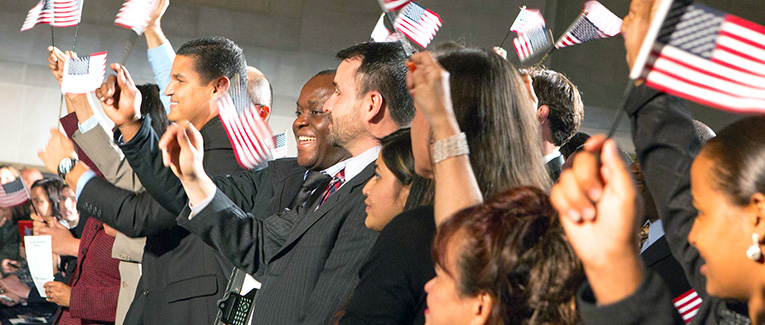
If the U.S. Citizenship and Immigration Services (USCIS) approves your application for naturalization, you must attend a ceremony and take the Oath of Allegiance to the United States. The USCIS will notify you by mail for the time and date of your ceremony.
The notice the USCIS sends you is called the “Notice of Naturalization Oath Ceremony” (Form N-445). In some cases, the USCIS may give you the option to take the Oath on the same day as your interview. If you decide to take a “same day” oath, the USCIS would ask you to come back to the office later that day. At this time, you would take the Oath and receive your Certificate of Naturalization.
If you cannot go to the oath ceremony, you should return the “Notice of Naturalization Oath Ceremony” (Form N-445) that the USCIS sent to you. You should send the N-445 back to your local office, and include a letter saying why you cannot go to the ceremony. Make a copy of the notice and your letter before you send them to the USCIS. Your local office will reschedule you and send you a new “Notice of Naturalization Oath Ceremony” (Form N-445) to tell you when your ceremony will be. - Check in at the ceremony
When you arrive at the ceremony, you will be asked to check in with the USCIS. Try to arrive early. Remember that often there are many other people being naturalized with you who must also be checked in with the USCIS.
The naturalization ceremony is a solemn and meaningful event. Please dress in proper attire to respect the dignity of this event (no jeans, shorts, flip flops, etc). - Return your Permanent Resident Card
You must return your permanent resident card to the USCIS when you check in for your oath ceremony. You will no longer need your permanent resident card because you will get your Certificate of Naturalization at the ceremony. - Answer questions about what you have done since your interview
If more than a day has passed between your interview and the ceremony, the USCIS will ask you several questions. These questions will be on the back of the notice the USCIS sends you (Form N-445). Some questions on the back of the N-445 are: “Have you traveled outside the United States?” and “Have you claimed exemption from military service?” You should read these questions carefully and mark your answers before you arrive at the ceremony.
Important
Answer the questions on the back of the Form N-445 concerning only for the time since your interview. - Take the oath
You are not a citizen until you have taken the Oath of Allegiance at a formal naturalization ceremony. You will take the Oath during the ceremony. An official will read each part of the Oath slowly and ask you to repeat his or her words. The Oath can be found below.
Request a Modified Oath. If you provide enough evidence that your religious training and beliefs prevent you from bearing arms for the United States, you may take the Oath without the words “to bear arms on behalf of the Unites States when required by law..”
If you provide enough evidence and the USCIS finds that you are against any type of service in the armed forces because of your religious training and beliefs, you will not be required to say the words “to perform noncombatant service in the Armed Forces of the United States when required by law.”
If the USCIS finds that you are unable to swear the Oath using the words “on oath,” you may replace these words with “and solemnly affirm.” Finally, if the USCIS finds that you are unable to use the words “so help me God” because of your religious training or beliefs, you are not required to say these words.
If you believe you qualify for a modified Oath, you should write the USCIS a letter explaining your situation with your application. The USCIS will ask you to provide documentation from your religious organization explaining its beliefs and to state that you are a member in good standing.
If you cannot communicate an understanding of the meaning of the Oath because of a physical or mental disability, the USCIS may excuse you from this requirement.
Hereditary Titles. If you have any hereditary titles or positions of nobility, you must give them up at the oath ceremony.
Just before taking the oath, you will be asked to pledge your allegiance to the flag and sing the United States National Anthem. You do not have to memorize any of these. You will be given sheets of paper with these written on them.
After taking the oath, you may also hear a pre-recorded congratulating speech from the president of United States on a television welcoming all new U.S. citizens. - Receive your Certificate of Naturalization
Once you have taken the Oath, you will receive your Certificate of Naturalization. You may use this document as proof that you are a U.S. citizen.
Important
We strongly recommend that you go to your nearest Social Security Administration (SSA) office to update your Social Security record soon after your naturalization ceremony.
This is important because your Social Security record will be used to establish eligibility for benefits and to demonstrate authorization to work. The nearest SSA office can be found by calling 1-800-772-1213 or at www.socialsecurity.gov.
To Update your Citizenship with the SSA. In order to update your citizenship status on your SSA record, you will need to present your Certificate of Naturalization or your U.S. passport to the SSA.
To Change your Name in SSA’s Records. If at the oath ceremony you changed your name from what is shown on your SSA record and your Certificate of Naturalization does not show your old and new names, you will also need to present:- A state driver’s license or an other acceptable form of identification in your old name as shown on your SSA record. This identity document in your former name can be unexpired or expired. It must contain your photo and/or biographical information about you.
- If you changed your name more than two years ago, you will also need to present a recently issued identity document showing your new legal name as shown on your Certificate of Naturalization or U.S. passport.
Important: We strongly recommend that you apply for a U.S. passport soon after your naturalization ceremony.
A passport serves as evidence of citizenship and is easier to carry around than a Certificate of Naturalization. If you lose your Certificate of Naturalization, you may request a replacement by filing an “Application for Replacement Naturalization/Citizenship Document” (Form N-565). You can often get an application for a passport at your oath ceremony, at most United States Post Offices, or you can download it from this website.
Details about applying for U.S. passport.
Oath of Allegiance
The oath of allegiance is:
I hereby declare, on oath,
that I absolutely and entirely renounce and abjure all allegiance and fidelity to any foreign prince, potentate, state, or sovereignty, of whom or which I have heretofore been a subject or citizen;
that I will support and defend the Constitution and laws of the United States of America against all enemies, foreign and domestic;
that I will bear true faith and allegiance to the same;
that I will bear arms on behalf of the United States when required by the law;
that I will perform noncombatant service in the Armed Forces of the United States when required by the law;
that I will perform work of national importance under civilian direction when required by the law; and
that I take this obligation freely without any mental reservation or purpose of evasion; so help me God.
In some cases, USCIS allows the oath to be taken without the clauses:
“. . .that I will bear arms on behalf of the United States when required by law; that I will perform noncombatant service in the Armed Forces of the United States when required by law. . .”
Tips
- Before the oath, you will be shown your certificate of naturalization to make sure all the details are correct. Verify your name, date of birth, and all other details.
- Make sure that it has the signature of the director of the USCIS on it. Otherwise, the certificate is not valid.
- Once you receive your certificate of naturalization, make sure to sign it. Do not put your usual day-to-day signature on it. You have to write (NOT print) your entire name in cursive letters in the designated area.