


Overview
The Media (I) Visa is a non-immigrant visa category for representatives of foreign media traveling temporarily to the United States to perform professional media duties. To qualify, the applicant must represent a foreign media organization with its principal office located outside the United States. The applicant must also be entering the U.S. primarily to engage in informational or educational media activities, such as news gathering and reporting.
The U.S. Department of State determines eligibility for an I visa. Eligibility is based on the applicant’s role as a bona fide representative of foreign media and the reciprocal privileges granted to U.S. media representatives by the applicant’s country.
Representatives of foreign media may include:
- Reporters and correspondents
- Editors
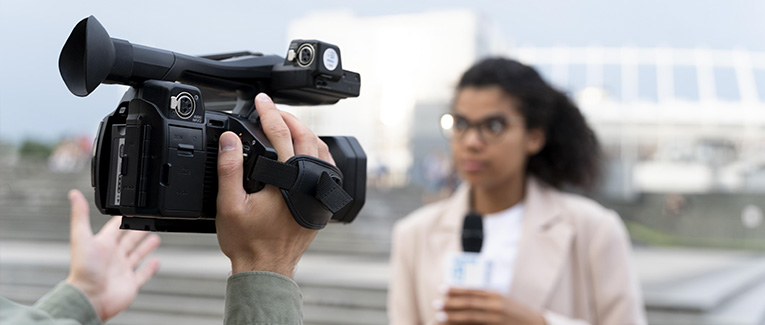
- Film and television crews engaged in news production
- Radio journalists
- Documentary production personnel involved in informational programming
- Technical personnel essential to media operations
- Other professionals whose activities are directly related to foreign media functions
Activities conducted in the United States under an I visa must generally be informational in nature and related to the gathering, production, or dissemination of news and current events. Activities focused primarily on commercial entertainment do not qualify for I visa classification.
Media professionals who intend to engage in qualifying media activities may not enter the United States under the Visa Waiver Program (VWP) or as B-1/B-2 visitors. An appropriate I visa must be obtained before travel.
Representatives of foreign media assigned to cover the United Nations may be subject to a different visa classification. Applicants should consult a U.S. embassy or consulate for guidance.
Application Process
Unlike many employment-based visa categories, an I visa does not require USCIS petition approval before a visa application can be submitted abroad.
Applicants typically apply directly at a U.S. embassy or consulate by:
- Completing Form DS-160, Online Nonimmigrant Visa Application.
- Paying the applicable visa application fee.
- Scheduling and attending a visa interview, if required.
- Providing documentation demonstrating:
- Employment with a qualifying foreign media organization;
- The nature of the media assignment in the United States; and
- Evidence that the media organization maintains its principal office outside the United States.
Period of Stay
Upon admission to the United States, I visa holders are admitted for Duration of Status (D/S). I visa holders may remain in the United States as long as they continue to engage in authorized activities for the qualifying foreign media organization and comply with the terms of their status.
Visa validity periods vary by nationality and applicable reciprocity schedules.
Employment Restrictions
An I visa holder may engage only in authorized media activities for the qualifying foreign media organization.
If an I non-immigrant wishes to change employers or work in a different media capacity while remaining in the United States, an application must be filed with USCIS requesting the appropriate change in status or employment authorization.
Study While in I Status
I visa holders may participate in part-time or incidental study, provided the study does not interfere with the primary purpose of their stay as media representatives.
Individuals who intend to pursue a full-time course of study should obtain an appropriate student classification.
Dependent Spouse and Children
The spouse and unmarried children under 21 years of age of an I visa holder may qualify for derivative I classification to accompany or follow to join the principal applicant.
Derivative I visas are not available to:
- Fiancés or fiancées
- Parents
- Siblings
- In-laws
- Other relatives
Application Procedure for Dependents
Dependents follow the same visa application procedures as the principal applicant.
If applying separately after the principal applicant has already received an I visa, dependents should provide evidence of the principal applicant’s valid I status, such as copies of the visa, admission records, and proof of the qualifying relationship.
Rights and Restrictions of Dependents
Employment
Derivative I spouses and children are not authorized to work in the United States solely based on their I status. To engage in employment, they must independently qualify for and obtain an appropriate work-authorized immigration status.
Education
Derivative I spouses and children may attend school or engage in full-time or part-time study in the United States without obtaining a separate F-1 student visa.
Temporary Visits
Family members who do not intend to reside in the United States with the principal I visa holder and are visiting for tourism or other temporary purposes should apply for an appropriate visitor visa classification, if required.