


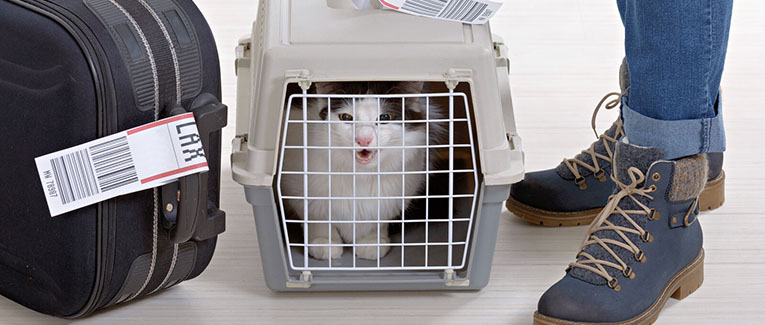
Travelers frequently inquire about taking their pets with them to the United States. All such importations are subject to health, quarantine, agriculture, wildlife, and customs requirements and prohibitions. Pets, except for pet birds, taken out of the United States and returned are subject to the same requirements as those entering for the first time. Returning U.S.-origin pet birds are subject to different import restrictions than pet birds of non-U.S. origin entering the United States for the first time. For more information on importing pet birds into the United States, see the below section on Birds or the Department of Agriculture’s Website.
Pets excluded from entry into the United States must either be exported or destroyed. While awaiting disposition, pets will be detained at the owner’s expense at the port of arrival.
The U.S. Public Health Service requires that pet dogs and cats brought into this country be examined at the first port of entry for evidence of diseases that can be transmitted to humans. Dogs coming from areas not free of rabies must have a valid rabies vaccination certificate. Turtles are subject to certain restrictions, and monkeys may not be imported as pets under any circumstances.
The U.S. Fish and Wildlife Service (USFWS) is concerned with the importation, trade, sale, and taking of wildlife and with protecting endangered plant and animal species. Some wildlife species of dogs, cats, turtles, reptiles, and birds—although imported as pets—may be listed as endangered. Endangered and threatened animal and plant wildlife, migratory birds, marine mammals, and certain dangerous wildlife may not be imported without special federal permits. Sportsmen will find the section on wildlife of particular interest, since game birds and animals are subject to special entry requirements.
We suggest that you also check with state, county, and municipal authorities for local restrictions on importing pets. Some airlines require health certificates for pets traveling with them. You should check with your airline prior to your travel date.
If you are taking a pet to another country, contact that country’s embassy in Washington, D.C., or its nearest consular office for information on any requirements that you must meet.
General Customs Information
All birds and animals must be imported under healthy, humane conditions. U.S. Department of Agriculture (USDA) regulations require that careful arrangements be made with the carrier for suitable cages, space, ventilation, and protection from the elements. Cleaning, feeding, watering, and other necessary services must be provided. Under the Animal Welfare Act, the Department of Agriculture is responsible for setting the standards concerning the transportation, handling, care, and treatment of animals. The U.S. Fish and Wildlife Service is responsible for ensuring humane transport of all imported animals and birds (except domesticated species) and all imported or exported wildlife protected under the Convention on International Trade in Endangered Species (CITES).
Every imported container of pets, or package of animal parts or products, must be plainly marked, labeled, or tagged on the outside with the names and addresses of the shipper and consignee, along with an accurate invoice specifying the number of each species contained in the shipment.
Since the hours of service and availability of inspectors from the other agencies involved may vary from port to port, you are strongly urged to check with your anticipated port of arrival before importing a pet or other animal. This will assure expeditious processing and reduce the possibility of unnecessary delays.
Customs Duty
Dogs, cats, and turtles are free of duty. Other pets imported into the United States, if subject to a customs duty, may be included in your customs exemption if they accompany you and are imported for your personal use and not for sale.
Pets and Wildlife
Purebred Animals
Purebred animals, other than domesticated livestock, that are imported for breeding purposes are free of duty under certain conditions. A declaration is required to show that the importer is a citizen of the United States; that the animal is imported specifically for breeding purposes; that it is identical with the description in the certificate of pedigree presented; and that it is registered in the country of origin in a book of registry recognized by the U.S. Department of Agriculture.
An application to the Department of Agriculture on VS Form 17-338 for a certificate of pure breeding must be furnished before the animal is examined at the designated port of entry. For complete information, write to the Animal and Plant Health Inspection Service, whose address is listed at the end of this page.
Birds
All birds—those that were taken out of the country as well as those being returned—are subject to controls and restrictions. In addition, nearly all birds coming into the country require a permit from the U.S. Fish and Wildlife Service.
To prevent the introduction of exotic diseases of poultry into the United States, the U.S. Department of Agriculture regulates the importation of all birds entering the country:
- Most birds must be quarantined upon arrival for a minimum of 30 days in a USDA Animal Import Center. The birds must enter the United States through one of three ports of entry where the quarantine facilities are located:
New York, NY ——— 718-553-1727
Miami, FL ——— 305-526-2926
Los Angeles, CA ——— 310-725-1970 - Quarantine space must be reserved in advance by contacting one of the USDA Animal Import Centers listed above. All quarantine fees must also be paid in full in advance.
- A USDA import permit is required for most imported birds. Permit application forms can be obtained by contacting the USDA Animal Import Center directly or found on the USDA website.
- All birds imported into the United States must be inspected by a USDA port veterinarian at the first U.S. port of entry. This inspection must be arranged in advance by contacting the port veterinarian at least 72 hours prior to travel. The phone number for the USDA port veterinarian will be located on the import permit, or it can be found on the USDA website.
- A current veterinary health certificate must accompany the bird. The health certificate must be endorsed by a national veterinarian of the country of export and be issued within 30 days of importation.
- Returning U.S.-origin pet birds may be quarantined in the owner’s home for a minimum of 30 days. In order to show proof of U.S. origin, the birds must be accompanied by a veterinary health certificate issued by a U.S. veterinarian prior to leaving the country.
- Birds imported from Canada are exempt from quarantine requirements. However, all birds must be examined by a USDA port veterinarian at the first U.S. port of entry. If the birds enter the United States via a U.S.-Canadian land border port, no import permit is required. If the birds enter via an airport, an import permit is required. The permit application can be obtained by calling 301-734-8364 or found on the USDA website.
More information on importing birds into the United States can be found on the USDA website or by contacting:
National Center for Import and Export
4700 River Road, Unit 39
Riverdale, MD 20737.
The telephone number is 301-734-8364, and the fax number is 301-734-4704.
Importers and exporters of all wild birds, including captive-bred, are required to obtain clearance from the U.S. Fish and Wildlife Service. Birds that are protected under the Convention on International Trade in Endangered Species (CITES) require permits to travel from one country to another, and import of these birds may be subject to permit requirements or restrictions under the Wild Bird Conservation Act (WBCA). Birds imported or exported anywhere other than a USFWS designated port may require payment of inspection fees.
To request a CITES and/or WBCA permit application, or to obtain more information, contact:
U.S. Fish and Wildlife Service
Office of Management Authority
4401 North Fairfax Drive, Room 700
Arlington, VA 22203
The toll-free telephone number is 800-358-2104. Overseas calls should be placed to 001-703-358-2104.
Cats and Dogs
Importation of cats and dogs is regulated by the Centers for Disease Control and Prevention (CDC).
It is illegal in the United States to import, export, distribute, transport, manufacture, or sell products containing dog or cat fur in the United States. The Dog and Cat Protection Act of 2000 calls for the seizure and forfeiture of each item containing dog or cat fur.
The Act provides that any person who violates any provision may be assessed a civil penalty of not more than $10,000 for each separate knowing and intentional violation, $5,000 for each separate gross negligent violation, or $3,000 for each separate negligent violation.
Cats – All domestic cats must be free of evidence of diseases communicable to humans when examined at the port of entry. If the animal is not in apparent good health, further examination by a licensed veterinarian may be required at the owner’s expense. Cats arriving in Hawaii or Guam, both of which are free of rabies, are subject to locally imposed quarantine requirements.
Dogs – Domestic dogs must be free of evidence of diseases communicable to humans when examined at the port of entry. If the animal is not in apparent good health, further examination by a licensed veterinarian may be required at the owner’s expense.
Vaccinations
Dogs must be vaccinated against rabies at least 30 days before entering the United States. This requirement does not apply, however, to puppies less than three months of age or to dogs originating from or located for at least six months in areas designated by the U.S. Public Health Service as being rabies-free. The following procedures pertain to dogs arriving from areas that are not free of rabies:
- A valid rabies vaccination certificate should accompany the animal. This certificate should be in English or be accompanied by a translation. It should identify the animal, the dates of vaccination and expiration, and be signed by a licensed veterinarian. If no expiration date is specified, the certificate is acceptable if the date of vaccination is no more than 12 months before the date of arrival.
- If a vaccination has not been performed, or if the certificate is not valid, the animal may be admitted if it is confined immediately upon arrival at a place of the owner’s choosing. The dog must be vaccinated within four days after arrival at the final destination, but no more than 10 days after arrival at the port of entry. The animal must remain in confinement for at least 30 days after being vaccinated.
- If the vaccination was performed less than 30 days before arrival, the animal may be admitted but must be confined at a place of the owner’s choosing until at least 30 days have passed since the vaccination.
- Young puppies must be confined at a place of the owner’s choosing until they are three months old, and then they must be vaccinated. They must remain in confinement for 30 days after the vaccination.
Dogs that arrive in Hawaii or Guam, both of which are free of rabies, are subject to locally imposed quarantine requirements, in addition to other Public Health Service requirements listed above that may apply.
Monkeys
Monkeys and other primates may be brought into the United States for scientific, educational, or exhibition purposes by importers who are registered with the CDC. However, under no circumstances may they be imported as pets. Registered importers who wish to import or export primates for a permitted purpose in accordance with CDC requirements are also required to obtain clearance from the U.S. Fish and Wildlife Service. The Convention on International Trade in Endangered Species (CITES) requires that all primates have permits.
Turtles, Tortoises, and Terrapins
Live turtles with a shell length of less than four inches (linear measure) and viable turtle eggs may not be imported for commercial purposes. An individual may import live turtles with shells less than four inches long if the importation is not for commercial purposes, and the importation includes less than seven live turtles, less than seven viable turtle eggs, or any combination of turtles and eggs totaling less than seven. The CDC may issue a permit for the importation of more than the permitted number if the importation is for a bonafide noncommercial scientific or exhibition purpose.
There are no Public Health Service restrictions on the importation of live turtles with a shell longer than four inches. Importers and exporters of all tortoises and terrapins must obtain clearance from the U.S. Fish and Wildlife Service. Importers should check with USDA regarding import restrictions for some tortoises.
Rabbits, Guinea Pigs, Hamsters, Ferrets, and Other Pet Rodents
There are no CDC or USFWS restrictions or requirements on these animals if brought in as pets.
Wildlife
The following categories of wildlife and fish are subject to certain prohibitions, restrictions, and permit and quarantine requirements:
- Mammals, birds, amphibians, fish, insects, crustaceans, mollusks, reptiles, coral, and other invertebrates.
- Any part or products, such as feathers, skins, eggs, and articles manufactured from wildlife.
Federal laws prohibit the importation or transportation of any wildlife or wildlife parts that violate state or foreign laws.
The following ports are designated for entry of all fish and wildlife: Atlanta, Baltimore, Boston, Chicago, Dallas/Ft. Worth, Honolulu, Los Angeles, Miami, New Orleans, New York/Newark, Portland, San Francisco, and Seattle. Most fish and wildlife imported or exported at a USFWS non-designated port require payment of inspection fees. All such packages and containers must be marked, labeled, or tagged to clearly indicate the name and address of the shipper and consignee, and the number and nature of contents. Wildlife in any form, including pets, imported into or exported from the United States must be declared and cleared on U.S. Fish and Wildlife Form 3-177 (Declaration for Importation or Exportation of Fish or Wildlife) by the U.S. Fish and Wildlife Service prior to release by U.S. Customs. Contact the U.S. Fish and Wildlife Service for further clearance requirements and for a copy of the pamphlets “Facts about Federal Wildlife Laws” and “Buyer Beware”. Domesticated pets, such as dogs, cats, hamsters, gerbils, guinea pigs, and rabbits, do not require clearance from USFWS. Also, contact the Animal and Plant Health Inspection Service, which is listed toward the bottom of this webpage, for information about importing animal and bird products, such as hides, eggs, feathers, etc.
Game: Birds and Other Animals
Specimens of game birds and animals, other than protected species, that are legally killed by United States residents in Canada or Mexico may be imported for non-commercial purposes at any customs port of entry and declared on U.S. Fish and Wildlife Form 3-177. Game must be accompanied by a valid hunting license, tags, stamps, and by an export document from the country where taken, if such is required. Only United States residents may import game free of duty. Some game animals, such as black bears and elephants, require permits to be imported. Many countries also require export permits for all wildlife. Hunters should check with the U.S. Fish and Wildlife Service for permit and country requirements.
If the hunter wishes to import the meat, they must have a letter from a butcher indicating that the animal/bird was of Canadian origin and dressed at their butcher shop. All migratory birds must be imported with one wing attached for identification purposes.
United States residents may only import migratory game birds that they themselves have legally killed. The U.S. Fish and Wildlife Service has regulations regarding the number and species of migratory game birds that may be imported from Canada, Mexico, and other countries. Hunters should familiarize themselves with the restrictions on migratory game birds taken legally during open season in other countries; hunters should also be aware that some countries require wildlife export permits. Certain USDA restrictions may also apply. Contact the Veterinary Services (VS) Veterinarian in Charge in your state. For a list of offices and telephone numbers, you should contact VS, Technical Trade Services, Animal Products Staff in Riverdale, MD, which is listed in the last section of this page.
Game birds and waterfowl that are being imported as trophies must be sent to a taxidermy facility that has been approved by the USDA’s Veterinary Services. A list of approved taxidermists in a particular state can be obtained from the Technical Trade Services, Animal Products Staff, National Center for Import-Export at 301-734-8364.
Many animals, game birds, products, and byproducts from such animals and game birds are prohibited, or allowed only restricted entry into the United States. Specific requirements vary according to the country of export; for more information about importation by country, please call the U.S. Department of Agriculture (USDA), Animal and Plant Health Inspection Service (APHIS), the National Import-Export Center, at 301-734-3277, or by fax 301-734-8226.
Endangered Species
Some wildlife, including pets, are listed as threatened or endangered under the U.S. Endangered Species Act (ESA) and are prohibited from import or export unless authorized under a permit. The United States is a party in the Convention on International Trade in Endangered Species of Wild Fauna and Flora, commonly known as CITES. This treaty regulates trade in endangered species of wildlife, plants, and their products. International trade in species listed by CITES is illegal unless authorized by a permit. Items restricted by CITES include, but are not limited to, articles made from whale teeth, ivory, tortoise shell, reptile, fur skins, coral, and birds. Permits to import into or export from the United States and re-export certificates are issued by the Division of Management Authority of the U.S. Fish and Wildlife Service. Information on wildlife and plants, including lists of endangered species, may be obtained from that agency.
Finding Additional Information
Although essential requirements are described here, all regulations cannot be covered in detail. If you have any questions, write or call your local Customs office or the specific agency mentioned. Their addresses and websites are:
U.S. Public Health Service
Centers for Disease Control and Prevention Division of Global Migration and Quarantine (E-03)
Atlanta, GA 30333
Tel: 404-498-1670
https://www.cdc.gov/ncezid/dgmq/
Animal and Plant Health Inspection Service Technical Trade Services, Animal Products Staff U.S. Department of Agriculture National Import/Export Center
4700 River Road, Unit 40
Riverdale, MD 20737-1231
Tel: 301-734-8364
Fax: 301-734-8226
https://www.aphis.usda.gov/aphis/home
To obtain wildlife permits:
U.S. Fish and Wildlife Service Division of Management Authority
4401 N. Fairfax Drive, Room 700
Arlington, VA 22203
Tel: 703-358-2104
https://www.fws.gov/international/
For clearance ports and inspection fees:
U.S. Fish and Wildlife Service Office of Law Enforcement
4401 N. Fairfax Drive, Room 500
Arlington, VA 22203
Tel: 703-358-1949
www.fws.gov/le/
E-mail: [email protected]
U.S. Customs Service
1300 Pennsylvania Ave., NW
Washington, DC 20229
Tel: 202-354-1000
www.cbp.gov
Based on the brochure by U.S. customs