


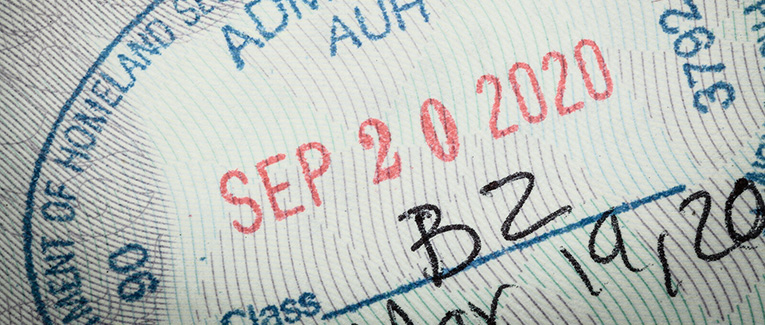
In many countries, a visa is directly tied to a person’s immigration status. However, in the United States, a visa stamp expiration date and the authorized duration of stay in the United States are two entirely different things.
What is a US Visa?
A visa is permission to request to enter the United States. Citizens of most foreign countries generally require visas to enter the United States. A visa is a document affixed to a page in the passport.
Most visas are issued at one of the Department of State’s embassies and consulates abroad, and the person must apply there first for a visa if required.
For this discussion’s purposes, a visa is a nonimmigrant visa issued to a person that wants to come to the US temporarily for a specific purpose, such as tourism, business, study, temporary work, etc. On the other hand, an immigrant visa allows the person to stay and work in the US permanently.
A visa is not permission to enter the United States and does not guarantee entry into the US A visa simply indicates that a US consular officer has reviewed your application at a US Embassy/Consulate, and they have determined that you are eligible to travel to the port of entry (POE, which can be an international airport, a seaport, or a land border crossing) for a specific purpose, such as tourism, study, temporary work, a business meeting, etc.
Visa Expiration Date
A visa stamp has an expiration date. Unless voided or canceled, a visa is valid until the expiration date. Visa validity is the period from the visa issuance date to the visa expiration date.
As long as the visa is valid, a person can apply at the port of entry for entrance into the US, even on the last day of the visa expiration date.
A single-entry visa allows the person to apply to enter the US once.
A multiple-entry visa allows the person to apply to enter the US multiple times while the visa is valid, for travel for the same purpose. You don’t have to obtain a new visa every time you travel to the US as long as the visa is valid for the entry.
You can’t use the same visa to enter the US for a purpose different than for which it was originally issued. If you have a tourist visa (B-2 visa), you can’t use it later to enter the US at a later date. You need to first obtain a student visa (generally F-1 visa) before you can apply to enter the US to study.
Visa validity can sometimes be voided or canceled depending upon certain circumstances. If you overstay (stay beyond your authorized stay), as provided by the date in the I-94 at the port of entry or through extension, your visa will be voided or canceled automatically.
However, if you have filed a timely application for extension of stay or a change of status, if that application is pending and not frivolous, and if you did not engage in unauthorized employment, this normally does not automatically cancel your visa. However, if your application for extension or change of status is rejected, and if you are still in the United States at that time, you immediately incur an unauthorized stay, and your visa will be voided/canceled automatically.
If you have applied for an adjustment of status to become a permanent resident alien (“Green Card” holder), and if you are not on a valid H or L nonimmigrant status, you must apply for an Advance Parole before leaving the US Also, read EAD/AP vs. H/L.
The visa expiration date has nothing to do with the authorized length of your stay in the US for any given visit.
Duration of Stay – Form I-94
A US immigration officer of the Department of Homeland Security (DHS) determines whether to allow you to enter the United States and for how long you can stay for any particular visit.
When you arrive into the US, an immigration officer at the port of entry records either a date or “D/S” (Duration of Status) on your passport. They also record the “class of admission” (which corresponds to the visa class), such as B-2, H-1, etc. An immigration officer is an officer of the Department of Homeland Security’s Customs and Border Protection. That same information is recorded in their system, and you can print Form I-94 from the CBP containing that information.
If your Form I-94 contains a specific date, you are authorized to stay in the US until that date. You may even stay in the US on the last day. If you are entering the US as a tourist or H/L worker, your I-94 form will contain a specific date.
Some students, exchange program participants, and certain temporary workers (e.g., foreign diplomats) will be admitted for “duration of status”. If you have “D/S” in your Form I-94, you can legally stay in the US as long you continue your course of studies or remain in your exchange program or qualifying employment. The D/S notation allows the educational institution to extend or transfer one’s legal immigrant status as a student without any additional applications to USCIS.
The date on the Form I-94, Form I-94W, or D/S notation is the official record of your authorized length of stay in the US, and it is entirely different from the visa expiration date. E.g., your visa may be expiring after 7-8 years, or it might have already expired 3-4 months ago, but you are allowed to stay for the next 2 months in the US
Extension of Stay
If you would like to stay in the US beyond the date recorded in the I-94, you must apply for an extension of stay by filing Form I-539 with the USCIS. USCIS has the authority to grant or reject the extension of stay. If an extension of stay is granted, you will get an approval notice along with the new I-94 form with the new expiration date.
If a person’s legal nonimmigrant status is valid because of an extension of stay, change of employer (H-1 transfer), etc., but the visa stamp is expired, a person can legally stay in the US for the authorized stay duration. However, if such a person goes outside the US, they must get a visa stamp for the new nonimmigrant status before being allowed to enter the US again. Currently, there is no way to apply for a visa inside the US.
Change of Status
Application for change of nonimmigrant status, e.g., from student status to H-1 status, must be filed with the USCIS by filing Form I-539. While the person may change to a valid nonimmigrant status, such as H-1, without having a new visa stamp in their passport, if such person goes outside the US, they must get a visa stamp for the new nonimmigrant status before being allowed to enter the US again. Currently, there is no way to apply for a visa inside the US
Tips
- H-1 workers should be aware of the period of stay granted on the I-94; immigration officers tend to grant the period of authorized stay only up to the validity of the visa when entering under the portability rules.
- If the person is entering the US on a visitor visa, it is possible to enter the US even on the last day of the visa stamp and get a 6-month stay authorized at the port of entry.
- If the person has a 10-year multiple entry tourist visa, that does not mean the person can stay in the US for 10 years. Such a person would usually be given a 6-month stay authorization at the port of entry, which can then be extended up to another 6 months by filing a visitor visa extension. This means that such persons must go back to their home country after staying a maximum of 1 year in such cases. However, that does not mean that you can return to your home country for 1 month and come back to the US again and try to stay in the US for another 6 + 6 months—and then try to do the same thing again. While there is no official rule regarding how long a person should stay outside the US and how long inside the US, if the person tries to spend more time in the US compared to outside the US (some people try to spend as much time as possible in the US), that is not consistent with the purpose of the tourist visa. A tourist visa is given to the person to tour the country and not stay here the majority of the time. If you are caught doing this, your next entry may be limited to 1 month or 1 week. Alternatively, you may even be denied entry altogether and sent back to your home country. People have been sent back from the airport, and it regularly happens to such abusers.